
Dressing the Millstones
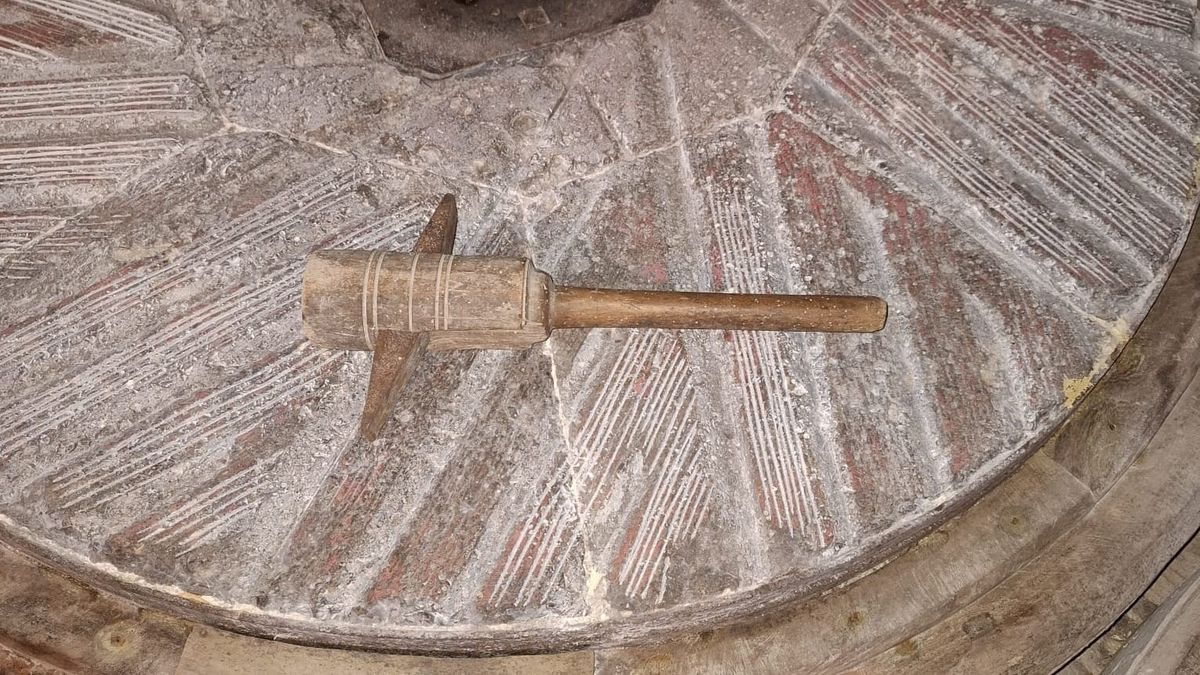
One of the regular maintenance jobs at New Hall Mill is dressing the millstones. Here you can watch the process on YouTube:
This task has nothing to do with getting dressed up for a party or well-dressing with flowers. At a watermill, dressing is the process of sharpening, re-grooving, and re-levelling the grinding surfaces of the millstones.
A millstone has a geography all its own. The large grooves are called furrows; the small grooves are called stitching; and the flat areas are called lands. The furrows feed the grain out onto the lands, as well as ventilating the stones and keeping them cool. That’s important because if the flour overheats, it can burn or even explode! The smaller stitching turns the grain into flour.
The runner stone – the one that turns – is very slightly concave. In the centre, at the eye of the stone, is the swallow, where the grain enters. This concave area is only about a millimetre shallower than the outer area, but this tiny difference is enough for a small build-up of grain to start working its way out through the pattern of grooves. The further the grain moves towards the edge of the stone, the finer the flour becomes.
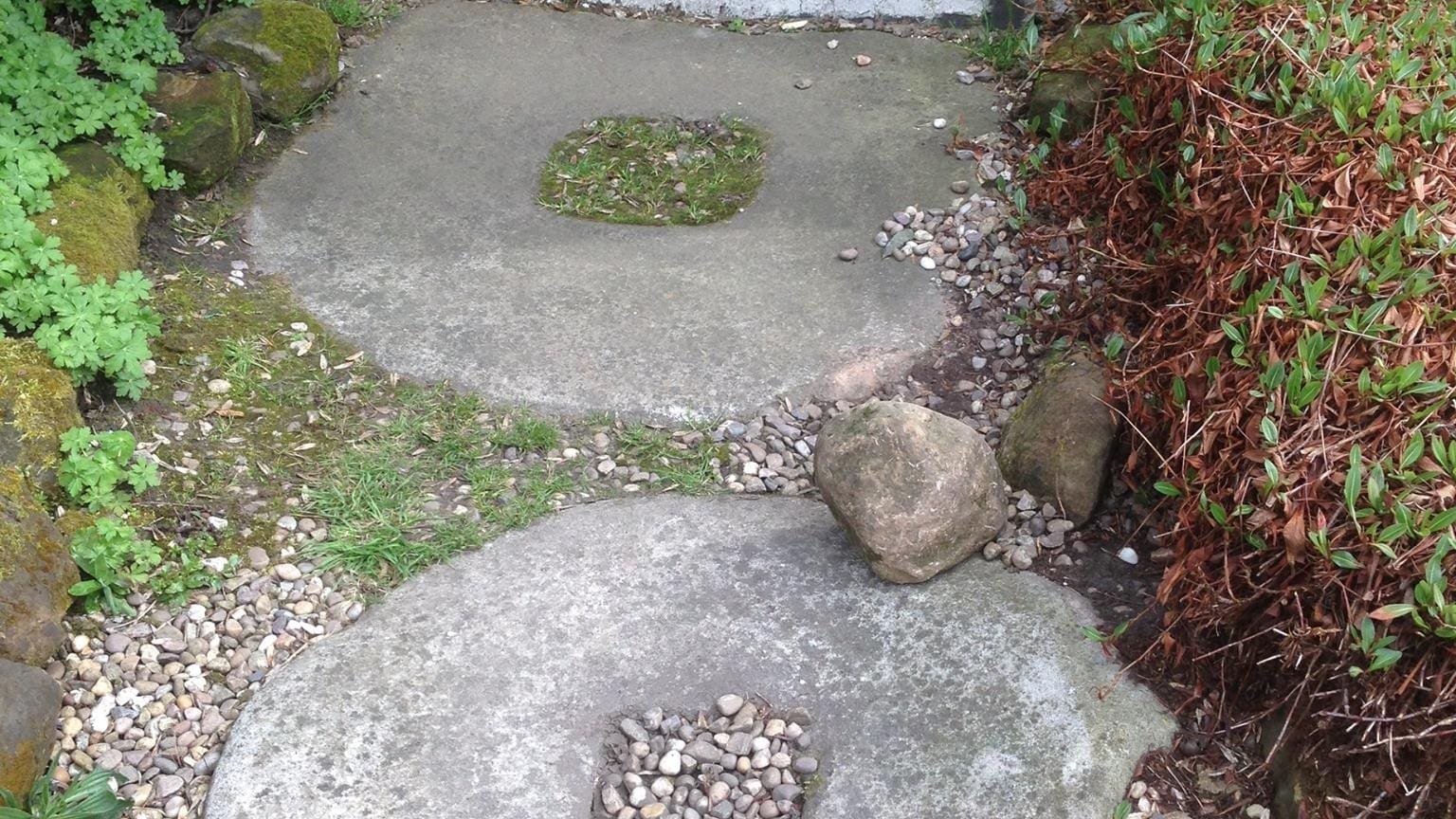
Over time, friction erodes the stones, reducing their ability to grind. You can see some old worn-out millstones around our grounds. Sandstone millstones like these are quite soft, and you can see how the grooves have worn away.
Our working millstones are French burr stones. They come from a quarry just outside Paris. We believe it’s now buried under Euro Disney. Burr stones are very hard and heavy. Because of their great weight, they would have been transported by ship in sections and assembled on site.
We aren't sure when our current stones arrived at the mill, but we do know that they were last dressed in 2014, and many of our team of millers and volunteers were involved, including Sam Sweet, Alan Dawson, and John Bedington.
On that occasion, our team spent many hours chipping away at the stones in the traditional way, with a hand-held bill or pick, (that’s a type of chisel) and a thrift, (that’s the traditional wooden handle used to hold the bill). In the end, they resorted to using an angle grinder. It made life a lot easier, but the downside was that it was incredibly noisy and dusty.
We’ve been aware for a year or two that our stones needed redressing. After the last open day in 2025, we separated the stones and cleaned them thoroughly. This involved plenty of scraping, chipping and vacuuming. If any trace of flour was left, it would set like concrete.
In March this year, 2026, a stonemason who helps at Stanway Mill, Richard Podd, was kind enough to come and show some of our team how to dress the stones. He began by looking at the general state of the stones and looking in particular for any smooth spots where the stitching was beginning to disappear.
A staff is a long piece of wood with a straight edge. Richard coated it with raddle, then rubbed it over the stones to make the high spots show up. These days edible food colouring is used for the raddle.
Traditionally, raddle was a mixture of animal fats and fluids, coloured with an ochre pigment. The same mixture was used on the underside of rams when they were out mating with ewes, so the farmers could check how busy the rams had been!
This time, there was no fussing with bills and thrifts! Richard Podd showed us how to dress the stones the modern way with an angle grinder. The grinder was held at a very shallow angle to deepen and shape the larger furrows. Then the grinder was held on edge to redefine the fine stitching grooves.
Our volunteers, Keith and Roger, were especially hands-on and got very dusty while getting to grips with the process. However, we got lucky with a very windy day, so the wind blew a lot of the dust straight out of the window towards the pond.
We hope that the work we did this year will last for about ten years, but we do like to grind our flour fine, and that’s harder on the stones as they have to run incredibly close together. In the past, we suspect the millers ground coarser flour so the stones could be run more 'open' and they’d last longer.
We were excited to reassemble the stones in May to see how well they performed. We are now reassured by the thought that if they ever needs a little extra work, we have a good idea of what to do.