
Codd Bottles
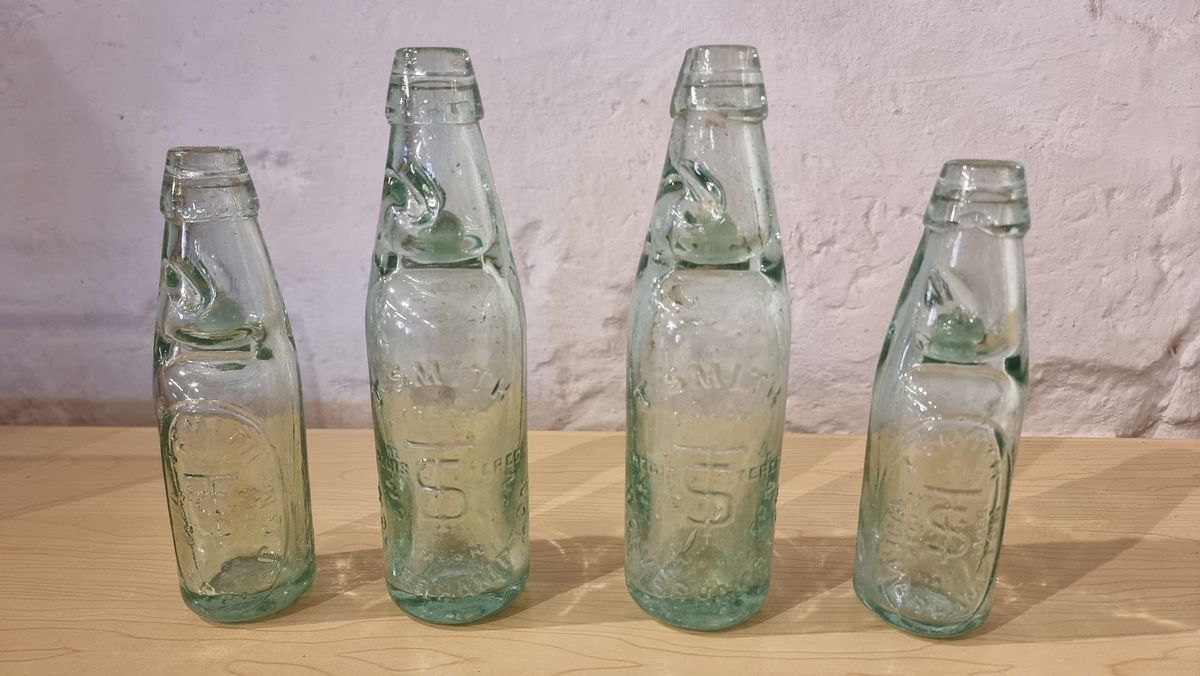
Between 2020 and 2021, the Friends excavated an old gear wheel pit belonging to a former water wheel on the northern side of the mill. Here the volunteers found several Codd bottles made by Thomas Smith from Penn Road, Wolverhampton, bearing the TS registered trademark. You can usually see them in the Stable on Open Days.
Codd bottles are specially designed glass bottles for carbonated drinks, invented by Hiram Codd in 1872. They use internal gas pressure to push a glass marble against a rubber washer in the bottle's neck, creating an airtight seal.
The unbroken condition of our bottles suggests that no children lived at the mill when they were discarded, as any children would have been eager to smash the bottles to release the glass marbles in the necks.
There were two methods for pouring from a Codd bottle. Some bottles feature a special tool to push the marble down. Others must be tilted so the marble is trapped in the bottle's pinched neck or throat, allowing the fizzy drink to be poured out. Perhaps most common was thumping the bottle in such a way that the marble was dislodged.
This technique is often said to be the origin of the term 'codswallop'. However, the first use of the word "codswallop" I have found was in a funny newspaper article in 1947, 75 years after Codd's invention, about the fictitious character Sir Aubrey Codswallop.
Thomas Smith advertised in the Wolverhampton Express and Star in April 1875:
Thomas Smith, Manufacturer of Soda Water, Ginger Beer, Lemonade etc., Penn Road, Wolverhampton, begs to inform the public that he has, under the advice of an eminent analyst whom he has consulted, made extensive alterations and additions to his premises and machinery, etc., in order to produce first-class aerated waters, and begs respectfully to call attention to the under-written certificate of the Borough and County Analyst, to whom he submitted samples of his soda water:
Laboratory of Analytical Chemistry, 10 Victoria Street, Wolverhampton, 31st March, 1875.
I have carefully examined the sample of soda water, and find it perfectly free from any injurious metallic contamination. It is made with wholesome water; is well aerated with carbonic acid; contains a fair amount of carbonate of soda; and possesses all the properties of a good soda water.
EWT Jones FCS, Public Analyst for South Staffordshire and Wolverhampton.
Thomas Smith's bottles continued to be made until the end of the 19th century.